What I’m Reading: World War Z

What I'm Reading


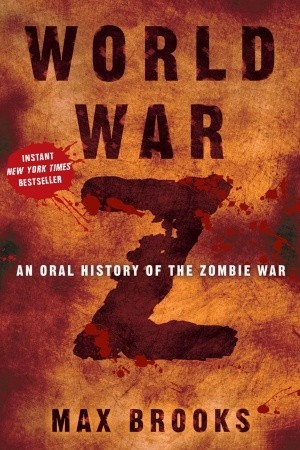
From Goodreads.com:
The Zombie War came unthinkably close to eradicating humanity. Max Brooks, driven by the urgency of preserving the acid-etched first-hand experiences of the survivors from those apocalyptic years, traveled across the United States of America and throughout the world, from decimated cities that once teemed with upwards of thirty million souls to the most remote and inhospitable areas of the planet. He recorded the testimony of men, women, and sometimes children who came face-to-face with the living, or at least the undead, hell of that dreadful time. World War Z is the result. Never before have we had access to a document that so powerfully conveys the depth of fear and horror, and also the ineradicable spirit of resistance, that gripped human society through the plague years.

Ranging from the now infamous village of New Dachang in the United Federation of China, where the epidemiological trail began with the twelve-year-old Patient Zero, to the unnamed northern forests where untold numbers sought a terrible and temporary refuge in the cold, to the United States of Southern Africa, where the Redeker Plan provided hope for humanity at an unspeakable price, to the west-of-the-Rockies redoubt where the North American tide finally started to turn, this invaluable chronicle reflects the full scope and duration of the Zombie War.

Most of all, the book captures with haunting immediacy the human dimension of this epochal event. Facing the often raw and vivid nature of these personal accounts requires a degree of courage on the part of the reader, but the effort is invaluable because, as Mr. Brooks says in his introduction, “By excluding the human factor, aren’t we risking the kind of personal detachment from history that may, heaven forbid, lead us one day to repeat it? And in the end, isn’t the human factor the only true difference between us and the enemy we now refer to as ‘the living dead’?”

Note: Some of the numerical and factual material contained in this edition was previously published under the auspices of the United Nations Postwar Commission. …

(Continue reading the full description here)

My review:
I first heard about this book back when it was announced that Brad Pitt would be starring in the movie adaptation of it. I never really paid much attention to the book or the movie, even, despite my affliction towards the undead and everyone’s fascination with them. Kyle was needed some reading material for his lunch breaks during night shift at work, so I bought the book for him through Amazon. He really loved it, so I thought I’d give it a go.

My first impression through reading it was, how on earth did they figure out a plot line for the movie? I’ve yet to watch it, but I’m curious to see which route they took.

My second impression was simply, “Wow.” Max Brooks really did an amazing job thinking every small aspect through of the “Zombie War.” He thought of how the living dead would impact every country, every city, every individual in the world. Some of the “people” he “spoke” with had quite amazing stories to tell. Some of the sections really pulled me in, the way good journalism should, however some sections were just OK. (Not the writing, but the stories that were being told.) There were several individuals who made reference to famous people, and it really made me stop and try to figure out who exactly was being referenced. (In one section, I’m certain the Queen on England herself was being mentioned slyly)

Once I got the general feel of the book, I really couldn’t put it down. It’s realistic, and it really brings the idea of a zombie apocalypse to the light of being a possibility.

Overall, I give World War Z: An Oral History of the Zombie War 4 ½ Stars out of 5.


What I’m Reading: The Birth House

What I'm Reading

From Goodreads.com:
The Birth House is the story of Dora Rare, the first daughter to be born in five generations of the Rare family. As a child in an isolated village in Nova Scotia, she is drawn to Miss Babineau, an outspoken Acadian midwife with a gift for healing and a kitchen filled with herbs and folk remedies. During the turbulent years of World War I, Dora becomes the midwife’s apprentice. Together, they help the women of Scots Bay through infertility, difficult labors, breech births, unwanted pregnancies and even unfulfilling sex lives.

When Gilbert Thomas, a brash medical doctor, comes to Scots Bay with promises of fast, painless childbirth, some of the women begin to question Miss Babineau’s methods – and after Miss Babineau’s death, Dora is left to carry on alone. In the face of fierce opposition, she must summon all of her strength to protect the birthing traditions and wisdom that have been passed down to her.

Filled with details that are as compelling as they are surprising-childbirth in the aftermath of the Halifax Explosion, the prescribing of vibratory treatments to cure hysteria and a mysterious elixir called Beaver Brew-The Birth House is an unforgettable tale of the struggles women have faced to maintain control over their own bodies and to keep the best parts of tradition alive in the world of modern medicine.

My review:
Today in Canada, or at least in BC, pregnant women have the option to choose a midwife or a doctor for their pre- and post-natal care. Both are covered through health care and both are fully capable of delivering a baby into the world in a safe and efficient manner. I picked up this book to read not only for the Canadian content, but to maybe understand midwives a little bit more.

Back in the early 1900’s, especially in the rural communities such as Scots Bay, NS, midwives like Dora Rare and Miss. B were the ones who “caught” babies. There was no official schooling, just methods passed down from teacher to student. I really like reading this book and it really opened up my thoughts to midwives. Miss B is a wise lady and is rightfully sceptical of Dr. Thomas. Canada was still a very young country at this time, especially in rural areas, and the change of time was slower. New methods of medicine, in the case of this story, childbirth, were not always welcomed with open arms. The doctor’s “Wham-bam” method of delivering babies leaves Dora and Miss B leery and afraid for the women of their community.

Like the Goodreads description states, there are several tidbits of information that spring true from the time period – The Halifax explosion, the hysteria treatments (which made me laugh a little bit), as well as the influenza outbreak in Boston.

I really enjoyed this book not only for the historical factor, but also for the medical factor. It shows not only how much medicine has changed over the years, but also the roots of some of the herbal medicine you see today. Many of the herbal remedies that were mentioned in The Birth House I’ve heard of today. Dora’s story is also compelling – her journey through midwifing, love, and loss drew me in.

Overall, I give The Birth House 4 stars out of 5.

Reading the book didn’t make me want to ditch my doctor and switch to a midwife for my next pregnancy, because I don’t think doctors today are as radical as they were back then, but like I said, it opened my eyes. Midwives are just as capable of delivering babies as doctors, and tend to show more compassionate care than some doctors (Not that doctors don’t show compassion, because many do).

What are your thoughts on Midwives vs. Doctors? If you’ve had a baby – What made you decide which one to “use?” If you haven’t – which route do you think you’ll go with? Why?

What I’m Reading: Unbearable Lightness

What I'm Reading

Synopsis from Goodreads.com:
“I didn’t decide to become anorexic. It snuck up on me disguised as a healthy diet, a professional attitude. Being as thin as possible was a way to make the job of being an actress easier . . .”

Portia de Rossi weighed only 82 pounds when she collapsed on the set of the Hollywood film in which she was playing her first leading role. This should have been the culmination of all her years of hard work—first as a child model in Australia, then as a cast member of one of the hottest shows on American television. On the outside she was thin and blond, glamorous and successful. On the inside, she was literally dying.

In this searing, unflinchingly honest book, Portia de Rossi captures the complex emotional truth of what it is like when food, weight, and body image take priority over every other human impulse or action. She recounts the elaborate rituals around eating that came to dominate hours of every day, from keeping her daily calorie intake below 300 to eating precisely measured amounts of food out of specific bowls and only with certain utensils. When this wasn’t enough, she resorted to purging and compulsive physical exercise, driving her body and spirit to the breaking point.

Even as she rose to fame as a cast member of the hit television shows Ally McBeal and Arrested Development, Portia alternately starved herself and binged, all the while terrified that the truth of her sexuality would be exposed in the tabloids. She reveals the heartache and fear that accompany a life lived in the closet, a sense of isolation that was only magnified by her unrelenting desire to be ever thinner. With the storytelling skills of a great novelist and the eye for detail of a poet, Portia makes transparent as never before the behaviors and emotions of someone living with an eating disorder.

From her lowest point, Portia began the painful climb back to a life of health and honesty, falling in love with and eventually marrying Ellen DeGeneres, and emerging as an outspoken and articulate advocate for gay rights and women’s health issues.

In this remarkable and beautifully written work, Portia shines a bright light on a dark subject. A crucial book for all those who might sometimes feel at war with themselves or their bodies, Unbearable Lightness is a story that inspires hope and nourishes the spirit.

My review:
I had a general idea of how “deep” into your psyche eating disorders could get before I started reading de Rossi’s memoir. I knew that it was more than just not eating, more than bingeing and purging, but reading this book really opens your eyes to the though pattern and rationality that lurks behind anorexia and bulimia.

To say it simply, this book is scary. To think that a person can go as far as considering the amount of calories lip balm may contain is a whole new level of eat disorders, and it just goes to show how far one person can be willing to go to reach some vision of what an “acceptable” weight for models and actors. Sure, they may look and act glamourous and beautiful, but there is nothing beautiful about counting calories to such an extreme that you’re unable to live a normal live. The normalcy of it all is what’s also quite shocking – Not eating for days on end was normal for de Rossi.

In regards to the actual book itself, I could not put it down. I knew who de Rossi was before she married Ellen Degeneres, although I didn’t watch Ally McBeal (my mom did) or Arrested Development. I knew she had an eating disorder and overcome it, I just didn’t know how she developed it and how she overcome it. I found myself reading page after page so intrigued by her story and just wondering how much further she would take things, and when she finally decided that she was not thin and beautiful but sick and knocking on death’s door.

I think everyone should read this book, whether you have known someone with a disorder, have tried dieting, or just want more insight of how brutal this disorder can be. I finished the book with a lot of disbelief, but I thoroughly enjoyed it.

I give Unbearable Lightness 5 stars out of 5.